
 Call for Peace


Messages to Look for Peace
بسم اللہ الرحمن الرحیم
In the Name of Allah,
the Most Gracious, and the Most Merciful


Please Do Not
Undermine
The Layman
Ibadaah
[Submission]


Performance
of
As Salat


Discipline in Life
Etiquettes
Brothers and Sisters! 
Assalam o Alleyykum
[Peace be Upon You]
Allah sent mankind in this world to live
for a short space of time and given a Way of Life i.e. Deen e Islam to follow so that everyone can get closer to Him (SWT) and it was determined that
mankind has be in state of As Salat:
·
Iqamat as Salat (Research of Universe)
·
Performance of Salat
Brothers and Sisters! It is natural phenomenon that one who devises a way he also has to devise
a plan i.e. an outline of ‘Etiquettes’ to follow the ‘Way of Life’.
Brothers and Sisters! If we make an analysis of Essentials of Performance of Salat we will see that these are full of ‘Etiquettes’ which are required in everyone’s day to day life.
Brothers and Sisters! The Essentials of Performance of
Salat are:
·
Direction 
·
Takbeer e Tahreema
·
Qayyam [Standing] 
·
Raku [Bending] 
·
Sajdah [Prostrating] 

·
Qaidah [Sitting after second Prostration]
Brothers and Sisters! Lets us try to analyse an outline what etiquettes one can learn from the Essentials of As Salat.
·
Direction
Brothers and Sisters!
·
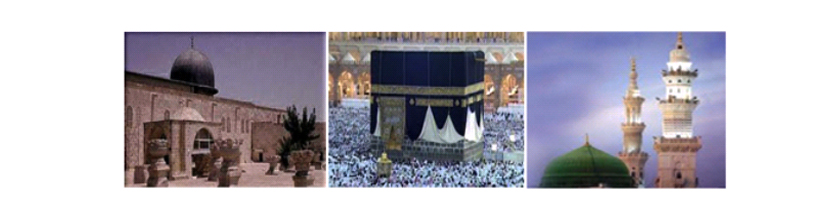
When Muslims have to perform Salat they have to face Bait Ullah at Makkah in Saudi Arabia.
Why?
· As per narrations Bait ul
Ma’mur where
there is Arsh of Allah is in Seventh
Heavens right above the Bait ullah. Brothers
and Sisters! So when Muslim has to perform Salat his direction is towards Allah.
Brothers and Sisters! This teaches the mankind a lesson that when they have
to converse with each other then the etiquettes of conversation is that they should face one another and while conversing eye contact should also be maintained.
Brothers and Sisters! You must have noticed that when somebody is addressing you if he does not face you and make eye contact with you, you feel offended.
Brothers and Sisters! So the etiquette mankind has learnt is that in day to day life when one is conversing or addressing a gathering
he must face them and maintain eye contact with them.
Takbeer e
Tahreema
Brothers and Sisters! Takbeer e Tahreema is a gesture where Muslim before starting to perform Salat he brings his hands along with his shoulders and shreds them behind his back and thereafter says: Allah ho Akbar  .
.
Brothers and Sisters! This means that as he is in the presence of Allah so he shreds the world behind his back so that he could exclusively  concentrate in making representations to Allah. By saying Allah ho Akbar he confesses that Allah is the Greatest and he is His (SWT) humble
  slave.
Brothers and Sisters! The Hikmah (Prudence) of Takbeer e Tahreema teaches mankind that when you are conversing or addressing then you must concentrate wholly and exclusively to the other party.
Qayyam
[Standing] 
Brothers and Sisters! The first part of performance
of Salat is to keep standing  and recite the Qur’an, in other words
making representations to Allah.
and recite the Qur’an, in other words
making representations to Allah.
Brothers and Sisters! The essential Qayyam teaches us that when one is conversing with a person who holds higher status then he should keep standing. For example: a student will not sit if his teacher is standing . This is a sign of humility and being obedient for the student.
Raku
[Bending]
Brothers and Sisters! When a Muslim is standing and making representations to Allah this is a sign of humility. But as Allah is Great and His (SWT) slave wants to show his humility at a higher level he bends down and puts his hands on his knees and praises His (SWT) Greatness.
Brothers and Sisters! The essential Raku teaches us that when one is speaking with or listening to a person of higher status then his head show be bowed. For example: when children are addressing or listening to their fathers advices they may not make eye contact with them.
Sajdah
[Prostration] 
Brothers and Sisters! When a Muslim has shown his humility by Raku (bending) he is not satisfied that he has shown his humility at the optimum level. So to show his utmost humility he prostrates and praises His (SWT) Greatness.
Brothers and Sisters! To prostrate other than Allah is forbidden. However, this essential teaches us that we must be obedient to our elders e.g. parents , teachers
  and authorities provided their commands are under the light of Qur’an and Hadith.
Qaidah
[Sitting after Prostration] 
Brothers and Sisters! Qaidah is state of sitting after second or fourth Rakat. A Muslim sits on his hams and
puts his hands on his thighs. In Qaidah he copies the dialogue between Allah and Khatim ul Anbiyya Hazrat Mohammed (SAW).
[The dialogue can be read under link: No 4 Gift of
Qaidah]
Brothers and Sisters! The state of Qaidah teaches us that when
we are sitting before our elders then we should be in
the state of Qaidah.
CONCLUSION
Brothers
and Sisters! The
above analysis is a very brief outline
of the Essentials of
Performance of Salat. However, you will gather that
every Essentials of performance of Salat has lessons
in it for our day to day life.
May Allah
be with You
Please Remember in Dua’as
Wass’a’lam
Naseer Aziz
Principal Call for Peace
Messages to Look for Peace
PS:
Sponsorship
Brothers and Sisters! Please read the Post: Sponsorship in the Navigation Bar as to why it is
needed to keep conveying the Messages to Look for Peace until the Day
of Resurrection and how it will be expended until the Day of Resurrection.
Wass’a’lam